
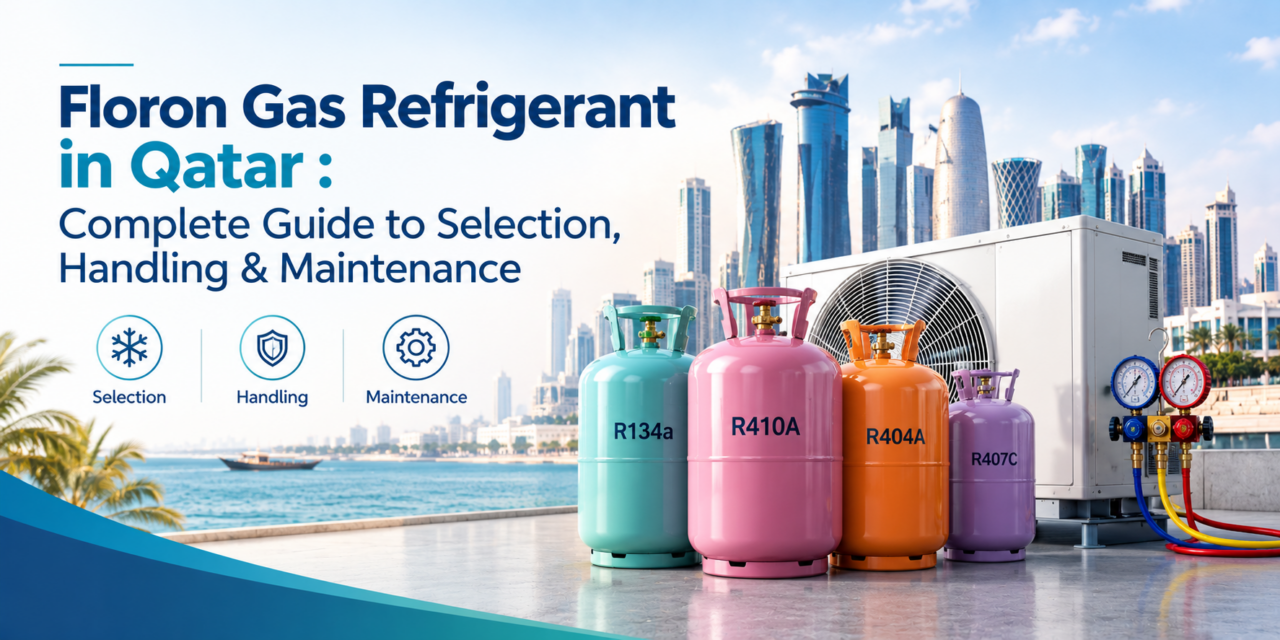
Choosing the correct refrigerant is one of the most important considerations when servicing or maintaining an air-conditioning or refrigeration system.
For customers searching for Floron gas refrigerant in Qatar, the requirement is usually practical: identify the correct refrigerant, source it from a reliable supplier and ensure it is handled and charged correctly.
Kazema Supply & Parts Qatar has a dedicated refrigerants portfolio and its website identifies Floron gas as a traceable refrigerant source in its current air-conditioner refrigerant guidance. Kazema’s older Floron article also provides detailed guidance on storage, transportation, leak detection, monitoring and safe handling.
One important point should always be made clear: refrigerants are not interchangeable simply because they are all used for cooling. The refrigerant must match the system’s original design and technical requirements.
This guide explains what Floron gas refrigerant is, how refrigerant selection works, what to check before purchasing, how to handle refrigerant cylinders safely and how Kazema’s refrigerant range can support HVAC+R requirements in Qatar.
Table of Contents
- What Is Floron Gas Refrigerant?
- Floron Gas Refrigerant in Qatar
- Why Refrigerant Selection Matters
- Understanding R134A
- Where Refrigerant Is Used
- How to Confirm the Correct Refrigerant
- Floron Gas and System Compatibility
- Buying Genuine Refrigerant in Qatar
- Checking the Cylinder Before Purchase
- Proper Refrigerant Storage
- Safe Transportation of Refrigerant
- Refrigerant Handling and PPE
- Refrigerant Charging
- Refrigerant Leaks
- Monitoring Refrigerant Levels
- Why Refrigerant Should Not Be Mixed
- Refrigerant Maintenance
- Refrigerant and Qatar’s Climate
- Kazema’s Refrigerant Range
- Floron and Other Refrigerant Requirements
- How to Choose a Refrigerant Supplier in Qatar
- Frequently Asked Questions
- Final Thoughts
What Is Floron Gas Refrigerant?
Kazema’s existing Floron article identifies Floron Gas refrigerant with HFC-134a and discusses its use in air-conditioning and refrigeration systems.
R134A is a refrigerant used in various HVAC+R applications.
However, the most important consideration when purchasing any refrigerant is not simply the brand or name.
The refrigerant must be compatible with the equipment.
Every system is designed around particular operating characteristics, including:
- Refrigerant type
- Pressure
- Temperature range
- Compressor
- Oil
- Expansion device
- System components
Using a refrigerant that does not match the equipment can cause performance problems or damage.
Floron Gas Refrigerant in Qatar
Qatar’s climate creates substantial demand for air conditioning and refrigeration.
Cooling systems operate for extended periods, particularly during the warmer months.
This means refrigerant availability and correct servicing are important for:
- Residential AC
- Commercial AC
- Refrigeration systems
- Cold rooms
- Commercial cooling
- Industrial HVAC+R systems
Kazema’s website currently provides a dedicated refrigerants range covering R22, R404A, R134A, R407C, R410A, R600A and R141B.
Its current air-conditioner refrigerant guide also specifically identifies Floron as an example of a traceable refrigerant source.
For a customer looking specifically for Floron gas, the next step should therefore be to confirm the exact refrigerant specification required by the equipment.
Why Refrigerant Selection Matters
A refrigerant is part of the system’s engineered design.
The compressor, condenser, evaporator, expansion device and refrigerant all work together.
Changing the refrigerant without confirming compatibility can affect:
- Cooling performance
- Operating pressure
- Compressor operation
- Energy consumption
- System reliability
- Component life
This is why “Which refrigerant is cheapest?” should not be the first question.
The first question should be:
Which refrigerant does this system require?
Only after that should availability, supplier and price be compared.
Understanding R134A
Kazema’s Floron article identifies Floron Gas refrigerant as HFC-134a.
R134A is used in HVAC+R applications and is included in Kazema’s current refrigerant portfolio.
Kazema’s broader air-conditioner refrigerant guide identifies R134A as being used in chillers, certain commercial refrigeration equipment and some packaged air-conditioning applications.
This does not mean R134A is suitable for every air-conditioning system.
It must be selected according to the manufacturer’s specifications.
If you are unsure which refrigerant your system uses, check the equipment nameplate or consult a qualified HVAC technician before purchasing or charging the system.
Where Refrigerant Is Used
Refrigerant systems are used across several environments.
Residential Air Conditioning
Residential systems use refrigerants to transfer heat and produce cooling.
The exact refrigerant depends on the equipment model.
Commercial Air Conditioning
Commercial systems can use larger refrigeration circuits and more complex controls.
Correct refrigerant selection is therefore important for maintaining system performance.
Refrigeration
Refrigeration systems used for food, beverages and other temperature-sensitive products depend on reliable refrigerant circulation.
Cold Rooms
Cold rooms require stable temperature control and correctly specified refrigeration equipment.
Industrial Applications
Industrial systems can have specific refrigerant and operating-pressure requirements.
The correct refrigerant should always be confirmed against the equipment design.
How to Confirm the Correct Refrigerant
Before purchasing Floron gas or any other refrigerant, follow these steps.
Step 1: Check the equipment nameplate
The manufacturer’s label normally identifies the refrigerant specified for the equipment.
Step 2: Check the service documentation
The equipment manual or service documentation can provide additional technical information.
Step 3: Identify the existing refrigerant
Do not assume the refrigerant based only on the age or appearance of the equipment.
Step 4: Confirm with a qualified technician
If the label or documentation is unclear, obtain professional confirmation.
Step 5: Match the refrigerant exactly
Do not substitute another refrigerant without confirming that the system has been designed or properly converted for it.
Floron Gas and System Compatibility
Compatibility is critical.
A refrigerant is not simply a generic “cooling gas.”
Different refrigerants can have different:
- Pressure characteristics
- Temperature characteristics
- Oil requirements
- Charging procedures
- Component compatibility
- Safety considerations
This is why a system designed for R134A should not simply be filled with R410A, R22 or another refrigerant because it is available.
Kazema’s current air-conditioner refrigerant guide explicitly states that refrigerants are not interchangeable and recommends checking the system nameplate before selecting refrigerant.
Buying Genuine Refrigerant in Qatar
When purchasing refrigerant, authenticity matters.
Counterfeit, relabelled or contaminated refrigerant can create serious problems for HVAC systems.
Kazema’s current air-conditioner refrigerant guide recommends verifying the source of refrigerant and specifically references traceable sources such as Refron or Floron gas.
Before purchasing, consider:
- Supplier reputation
- Cylinder condition
- Manufacturer identification
- Batch information
- Cylinder weight
- Product documentation
- Refrigerant type
- Required quantity
For commercial and industrial purchases, documentation and traceability can be particularly important.
Checking the Cylinder Before Purchase
The cylinder is the first physical product information you can inspect.
Check that:
- The cylinder is intact.
- The label identifies the refrigerant.
- The product information is clear.
- The cylinder has not been visibly damaged.
- The weight is consistent with the stated quantity.
- The cylinder is properly sealed where applicable.
Kazema’s current refrigerant guide recommends checking sealed cylinders, manufacturer identification or batch information, correct cylinder weight and documentation for commercial or industrial purchases.
If something does not look right, ask the supplier before using the product.
Proper Refrigerant Storage
Refrigerant cylinders must be stored appropriately.
Kazema’s existing Floron article recommends:
- Keeping cylinders upright
- Securing cylinders to prevent tipping
- Maintaining adequate ventilation
- Avoiding direct sunlight
- Keeping cylinders away from heat sources
- Avoiding open flames
Storage conditions matter because refrigerant cylinders contain pressurized product.
In Qatar’s hot climate, protection from excessive heat and direct sunlight is particularly important.
Storage should follow the cylinder manufacturer’s requirements and applicable safety regulations.
Safe Transportation of Refrigerant
Refrigerant cylinders should be transported carefully.
Kazema‘s Floron handling guidance recommends keeping cylinders upright and securely fastened during transportation.
Avoid:
- Dropping cylinders
- Dragging cylinders
- Leaving cylinders unsecured
- Exposing them unnecessarily to heat
- Transporting damaged containers
Transportation requirements should also follow applicable local regulations and the product manufacturer’s safety instructions.
For commercial quantities, businesses should ensure that the appropriate transportation and handling procedures are followed.
Refrigerant Handling and PPE
Refrigerant handling should be performed by trained personnel using appropriate equipment.
Depending on the task, appropriate protective equipment can include:
- Safety goggles
- Gloves
- Appropriate protective clothing
- Other PPE specified by the safety documentation
Kazema’s existing Floron article recommends appropriate PPE and adequate ventilation when handling Floron refrigerant.
Technicians should also use equipment designed for the refrigerant and application, including suitable gauges, recovery equipment, vacuum pumps and leak-detection tools.
Refrigerant Charging
Charging a refrigeration or air-conditioning system is not simply a matter of opening a cylinder and adding gas.
The technician should first determine why the refrigerant level is low.
If the system has lost refrigerant because of a leak, adding more refrigerant without repairing the leak does not solve the underlying problem.
The proper process depends on the equipment and refrigerant.
A qualified technician should:
- Inspect the system.
- Identify the refrigerant.
- Check for leaks.
- Repair leaks where required.
- Recover refrigerant where applicable.
- Evacuate the system according to the service procedure.
- Charge the correct refrigerant quantity.
- Check system operation.
The exact procedure should follow the equipment and refrigerant manufacturer’s instructions.
Refrigerant Leaks
A properly sealed refrigeration circuit should not require frequent refrigerant top-ups.
If a system repeatedly loses refrigerant, there may be a leak.
Possible warning signs can include:
- Reduced cooling
- Ice or frost on parts of the system
- Unusual sounds
- Reduced system performance
- Repeated need for refrigerant charging
Kazema’s Floron guide recommends regular inspection of refrigerant lines, connections and equipment to identify potential leaks.
Its current air-conditioner refrigerant guide also recommends investigating leaks instead of repeatedly topping up the system.
This is important because repeatedly adding refrigerant without correcting the leak can increase operating costs and leave the underlying problem unresolved.
Monitoring Refrigerant Levels
Monitoring system performance can help identify problems early.
Technicians can use appropriate pressure and temperature measurements to evaluate system operation.
A change from normal operating conditions can indicate:
- Refrigerant leakage
- Blockage
- Poor airflow
- Component problems
- Other system faults
Refrigerant levels should therefore be evaluated as part of a complete HVAC diagnostic process rather than treated as an isolated measurement.
Why Refrigerant Should Not Be Mixed
Different refrigerants have different properties.
Mixing refrigerants can alter the system’s expected pressure and performance characteristics and may complicate recovery and servicing.
Kazema’s current air-conditioner refrigerant guide explicitly advises against mixing refrigerant types.
If the refrigerant in a system is unknown or suspected to be incorrect, a qualified technician should identify the existing refrigerant and determine the appropriate service procedure.
Do not guess.
Refrigerant Maintenance
Refrigerant maintenance is really part of overall HVAC system maintenance.
A technician should consider:
- Refrigerant pressure
- Temperature
- Leak condition
- Compressor operation
- Condenser condition
- Evaporator condition
- Expansion device
- Electrical components
- Airflow
Kazema’s AC spare parts in Qatar guide discusses the broader HVAC maintenance ecosystem, including compressors, motors, refrigerants, expansion devices, electrical controls, copper components and tools.
This is useful because a refrigerant problem can sometimes be a symptom of another system issue.
Refrigerant and Qatar’s Climate
Qatar’s high temperatures make HVAC reliability especially important.
During periods of extreme heat, cooling systems can operate under high loads for long periods.
That makes correct refrigerant selection and system maintenance important.
However, it is not accurate to say that one refrigerant is automatically “the best refrigerant for Qatar.”
The correct refrigerant depends on the equipment.
For example, Kazema’s current refrigerant portfolio includes several refrigerants serving different HVAC+R applications.
The correct selection should therefore always start with the equipment manufacturer’s specification.
Kazema’s Refrigerant Range
Kazema’s dedicated refrigerants page currently identifies the following refrigerants in its portfolio:
- R22
- R404A
- R134A
- R407C
- R410A
- R600A
- R141B
The page describes applications and characteristics for each refrigerant.
This range is important because HVAC+R customers can have very different system requirements.
A residential AC system, commercial refrigeration system and industrial cooling system may not use the same refrigerant.
The correct product should therefore be selected according to the equipment specification.
Floron and Other Refrigerant Requirements
Floron gas should not be viewed separately from the rest of the refrigerant ecosystem.
A technician servicing an HVAC or refrigeration system may also need:
- Compressor
- Copper components
- Belts and bearings
- Controls
- Capacitors
- Fan blades
- Duct accessories
- HVAC tools
Kazema’s current website identifies these products as part of its wider HVAC+R offering.
For example, Kazema’s compressor portfolio includes Danfoss and other compressor brands, while its refrigerant portfolio covers multiple refrigerant types.
This allows HVAC professionals to investigate the wider system requirement rather than sourcing refrigerant in isolation.
How to Choose a Refrigerant Supplier in Qatar
When selecting a supplier for Floron gas refrigerant or another refrigerant, consider five areas.
- Product traceability
Can the supplier identify the refrigerant and its source?
- Product range
Does the supplier carry the refrigerant required by your system?
- Technical knowledge
Can the supplier help identify the product based on the system requirement?
- Availability
Is the required refrigerant currently available?
- Support
Can the supplier assist with sourcing and product enquiries?
Kazema’s website provides a dedicated refrigerants section as well as contact and showroom information.
Customers can contact Kazema with their refrigerant type, required quantity and application.
Floron Gas Refrigerant vs Choosing the Wrong Refrigerant
The biggest purchasing mistake is not necessarily choosing an expensive refrigerant.
It is choosing the wrong refrigerant.
Before buying, ask:
What does the equipment manufacturer specify?
Then verify:
Is the refrigerant available from a traceable source?
Then:
Is the quantity correct and is the product appropriate for the service requirement?
This sequence is safer and more practical than choosing a refrigerant based solely on price.
When Should You Contact an HVAC Professional?
You should seek qualified technical assistance when:
- The refrigerant type is unclear.
- The system has a suspected leak.
- The compressor is not operating correctly.
- The system requires recovery.
- The system requires evacuation.
- A refrigerant conversion is being considered.
- The system is repeatedly losing refrigerant.
- A commercial or industrial system is being serviced.
Refrigerant handling involves pressure, specialized equipment and safety considerations.
It should not be treated as a general DIY maintenance task.
Frequently Asked Questions About Floron Gas Refrigerant in Qatar
What is Floron gas refrigerant?
Kazema’s existing Floron article identifies Floron Gas refrigerant as HFC-134a and discusses its use in air-conditioning and refrigeration systems.
Where can I find Floron gas refrigerant in Qatar?
Kazema’s refrigerant portfolio includes R134A and its current air-conditioner refrigerant guide identifies Floron as a traceable refrigerant source.
Is Floron the same as R134A?
Kazema’s existing Floron article identifies Floron Gas refrigerant as HFC-134a, while its refrigerant portfolio separately lists R134A. Always confirm the exact product specification and system requirement before purchase.
Can I use Floron gas in any AC?
No. Refrigerant compatibility is system-specific. Check the equipment nameplate and manufacturer specification before charging.
Can different refrigerants be mixed?
Refrigerants should not be mixed simply because they are both used for cooling. Kazema’s current guidance specifically advises against mixing refrigerant types.
How do I know which refrigerant my AC needs?
Check the equipment nameplate and service documentation. If you are unsure, ask a qualified HVAC technician.
How often should refrigerant be refilled?
A properly sealed system should not require routine refrigerant refilling. Frequent top-ups can indicate a leak or another system problem.
How should refrigerant cylinders be stored?
Store cylinders upright and secured in an appropriate, ventilated area away from direct sunlight, excessive heat and ignition sources, following the manufacturer’s safety instructions.
Does Kazema supply other refrigerants?
Yes. Kazema’s current refrigerants page lists R22, R404A, R134A, R407C, R410A, R600A and R141B.
Can Kazema help with refrigerant selection?
Customers can contact Kazema with the equipment details, refrigerant requirement and quantity so the appropriate product can be identified.
Related Kazema Resources
For readers researching Floron gas and HVAC refrigerants, the following Kazema resources provide useful supporting information:
- Refrigerants in Qatar
- Air Conditioner Refrigerant in Qatar
- R410A Refrigerant in Qatar
- R22 Refrigerant in Qatar
- R22 Refrigerant: Current Usage & Transition Planning
- AC Spare Parts in Qatar
- Compressors in Qatar
- Contact Kazema
These links create a natural topical cluster around Floron → R134A → refrigerant selection → other refrigerants → compressors → HVAC spare parts → enquiry.
Final Thoughts
When searching for Floron gas refrigerant in Qatar, the priority should be correct product selection, authenticity, compatibility and safe handling.
Start with the equipment specification. Confirm the refrigerant type. Source the product from a traceable supplier. Then ensure that charging, recovery, leak detection and maintenance are performed using the correct equipment and qualified personnel.
Kazema’s refrigerant portfolio includes multiple refrigerant types for different HVAC+R applications, while its wider product range includes compressors, motors, controls, tools and other HVAC components.
For Floron gas or another refrigerant requirement, provide the equipment details and required quantity when contacting Kazema. This makes it easier to identify the appropriate product for the application.
Looking for Floron gas refrigerant in Qatar? Contact Kazema Supply & Parts Qatar for refrigerant availability, sourcing and HVAC+R requirements.